
For two days in September 2018, walkers crossed the Loos Salient above a battlefield that extends far below the fields and villages. Some also entered the Hulluch subway, passing through a portion of the underground network built, enlarged and defended during the First World War and altered again in 1940. The Loos Big Walk brought these two landscapes together: the positions that armies fought to hold on the surface and the tunnels that allowed them to live, move and fight beneath it.
A front across the coalfield
The Battle of Loos began on 25 September 1915. British forces took ground near Loos-en-Gohelle but failed to achieve the breakthrough they sought towards Lens. The resulting line passed through a densely contested coalfield of villages, spoil heaps and industrial sites. Around Hulluch, Hill 70, the Hairpin and the Hohenzollern Redoubt, the armies faced one another across ground exposed to shellfire and observation. Holding a position meant finding ways to bring forward men, ammunition and water, as well as preventing the enemy from doing the same.
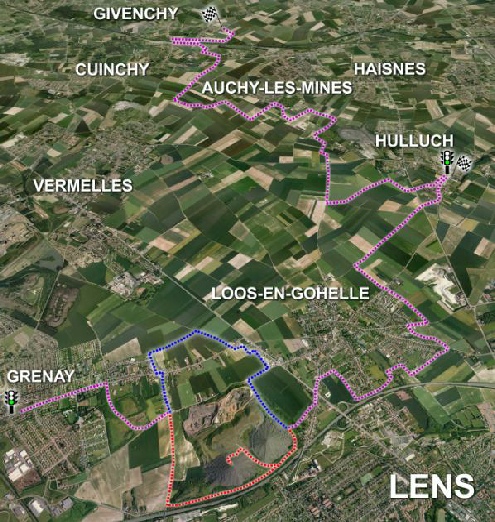
The route of the 2018 walk followed that history from Grenay through the Loos and Hulluch sectors towards Givenchy-lès-La-Bassée. It crossed a series of neighbouring positions, each with its own history of attack, defence and work underground. Canadian forces captured Hill 70 in August 1917, south of the Hulluch workings visited during the event. The walk connected these parts of the salient on the surface; it did not follow a single continuous tunnel underneath them.
First the miners, then the subway
After the front settled, British tunnelling companies drove small fighting galleries beneath and towards the German positions. Tunnellers listened for enemy digging and laid mines intended to destroy opposing works; they also tried to intercept the enemy’s galleries before charges could be fired. The craters near the Hairpin and Hohenzollern belonged to this prolonged struggle, which continued after the battle of 1915. At Hulluch and neighbouring St Elie, shafts and narrow passages formed separate mining works before later connections joined parts of them together.
The 253rd Tunnelling Company, Royal Engineers, worked in the Hulluch and St Elie sectors in 1916–17. Its records show the transition from mine fighting to larger passages for protected movement. By November 1916 the northern and southern communication tunnels at Hulluch had been joined, while work on the principal Hulluch Tunnel continued. The main subway was driven from late 1916 into early 1917. Where the fighting galleries were cramped routes towards the enemy, a subway was a wider route through which troops and stores could pass below artillery fire.
The names on the wartime plans mark routes and junctions within a developing network. Hulluch Subway was a principal passage; Northern Cut linked it to older mine workings. St Elie, with passages called Dudley, Devon and St George’s, was an adjoining system connected to the Hulluch routes. Other branches led towards trenches, dugouts and weapons positions. The existence of a connection on a plan does not mean every gallery remained open throughout the war or survives unobstructed today.
A working underground position
The expanded network was more than a means of crossing the battlefield. Narrow gauge track carried supplies through the subway; surviving sleepers, rail impressions and a turntable show how trolleys could be moved through junctions and into side passages. Passing places let men and loads travelling in opposite directions get by. Branches served heavy trench mortar batteries, whose weapons fired shells on a steep trajectory from positions close to the front. Ammunition and crews could approach under cover instead of crossing exposed ground.
A working underground position also needed water, light, air and communication. Wells and collection points supplied men below ground, while drainage pits dealt with water accumulating in the passages. Cable fixings and protected lamp fittings show where electric lighting and communications ran; soot on candle niches records a simpler source of light. Ventilation openings helped keep air moving. The mine rescue station held Proto breathing apparatus, needed when an explosion or gas made a gallery dangerous to enter. The 3rd Australian Tunnelling Company’s November 1917 diary records further railway, ventilation, water and accommodation work after the Australians assumed responsibility for the sector.
The walls preserve the human scale of this infrastructure. Names, unit marks and drawings were cut into the chalk in places where men worked or waited. The concentration of graffiti beside a water point makes sense in a passage repeatedly visited to fill containers. Such marks document the presence of individuals, although an inscription by itself cannot establish every detail of a soldier’s service or the exact date of a gallery’s construction.
A network prepared for attack
By 1918 the connected passages posed a defensive problem. If German troops took an entrance, they might exploit the underground links. Engineers installed gas doors and barriers that could divide the system. At Hulluch, a substantial movable blockade could close the principal passage; a firing opening allowed defenders to cover an approach. Arrangements were also made to deny a passage if it could no longer be held. These works show preparation for a possible breakthrough, not evidence that an enemy force entered the subway.
The feared German spring offensive began in Picardy on 21 March 1918; another major offensive struck farther north in Flanders in April. Neither overran the Hulluch system. The defenders nevertheless had to prepare for possibilities that could not be known in advance. Australian correspondent Charles Bean visited the Hulluch workings with Major Alexander Sanderson of the 3rd Australian Tunnelling Company in February 1918 and described an extensive underground defence in which infantry, weapons and supply routes were linked beneath the front.
A second war beneath Hulluch
In 1939–40, British engineers returned to the old passages as they prepared underground accommodation and working space for a proposed II Corps headquarters. 240 Field Company, Royal Engineers, and 170th Tunnelling Company cut new chambers and adapted older routes. Chalk from this work filled some First World War rooms and branches; a former railway siding became a place for spoil. The German invasion in May 1940 overtook the headquarters scheme before its intended use could be fully realised. New excavation and later inscriptions remain alongside the earlier rails, barriers and graffiti, giving the site a history across both world wars.
The walk of 22–23 September 2018




The centenary event set this underground history in the landscape above it. Participants could walk the route in two stages, from Grenay to Hulluch and then from Hulluch towards Givenchy-lès-La-Bassée, or take part in a run. Interpretation points along the way explained places and events that otherwise leave little visible trace on today’s ground. A commemorative gathering in Haisnes preceded the weekend, and a reception in Hulluch brought together volunteers and local supporters afterwards.
Following the route
The advertised route covered 26 kilometres over two days. These views trace its progress from the Grenay coalfield, past the Hulluch stop where guided visitors could enter the subway, to the finish near Givenchy-lès-La-Bassée. The marked lines show the surface walk and its optional sections; they are not a plan of the underground passages.


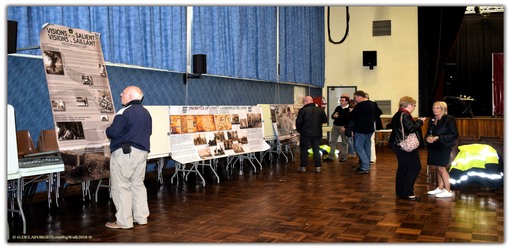
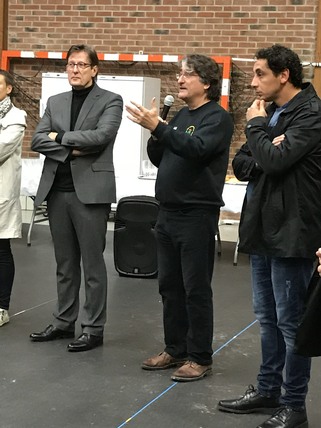
The Hulluch visit was a distinct, guided part of the programme. Small groups travelled along a selected stretch of the main subway, where guides could show the change from older mining passages to the larger supply route, the water point, railway remains, mortar links, blockade and later alterations. The event record reports about 300 participants overall and more than 200 visitors learning about the tunnels. Contemporary reporting in La Voix du Nord also described the walks and the exceptional underground visits. The controlled 2018 opening was an event, not a general invitation to enter the workings.
What remains beneath the fields
Surviving passages at Hulluch retain connections between mining, movement and defence that are difficult to understand from the surface alone. Other stretches of the wider salient are blocked, altered or inaccessible; a line drawn between neighbouring mining sectors on a modern map should not be mistaken for an intact walkable route. The Durand Group’s recording helps compare surviving features with wartime plans and accounts. Evidence from such work can inform landowners and officials considering the underground legacy, while an individual survey or visit does not itself amount to a completed determination of risk to land or infrastructure.
The Big Walk allowed visitors to read the battlefield in two directions. Above ground, they crossed the positions that shaped the fighting from 1915 onwards. Below it, the Hulluch subway showed how British and Australian engineers answered the daily demands of that front, and how another generation reshaped the same chalk when war returned.
Sources and further reading
- National Army Museum, “Battle of Loos”; Veterans Affairs Canada, “Battle of Hill 70”.
- The National Archives, war diary and weekly mining reports of 253rd Tunnelling Company, Royal Engineers, 1916–17; Institution of Royal Engineers, The Work of the Royal Engineers in the European War, 1914–19: Military Mining (1922), Plate V, for the period plan.
- Australian War Memorial, 3rd Australian Tunnelling Company war diaries, AWM4 16/4, especially November 1917, AWM4 16/4/21 and February 1918.
- Charles Bean, account of a February 1918 visit with Major Alexander Sanderson; German Historical Museum, chronology of 1918 for the geography of the spring offensives.
- La Voix du Nord, 18, 23 and 24 September 2018, contemporary reports on the Loos Big Walk and Hulluch visit.